



Blackjack is the most popular casino card game in existence. The game is entertaining, simple to learn, and widely available at gambling venues worldwide. The immense interest it attracts can also be explained by the fact that it is among the few casino games to offer players good odds of beating the house.
Thanks to the technological progress of the last few decades, many online casinos have introduced new and enticing blackjack variations, further fueling interest in this centuries-old game.
Players now have the unique opportunity to play blackjack at live dealer casinos from the comfort of their homes, without having to drive for hours to find a land-based venue that offers the game.
And don’t worry if you lack a knack for statistics or math. We at SuperCasinoSites have compiled all the information you need to master the game of blackjack in a clear and concise manner. If you are an absolute beginner, we suggest you start with the basics.
Blackjack Fixed Rules and Card Values
Basic Rules
Card Values
Moves
Surrender and Insurance
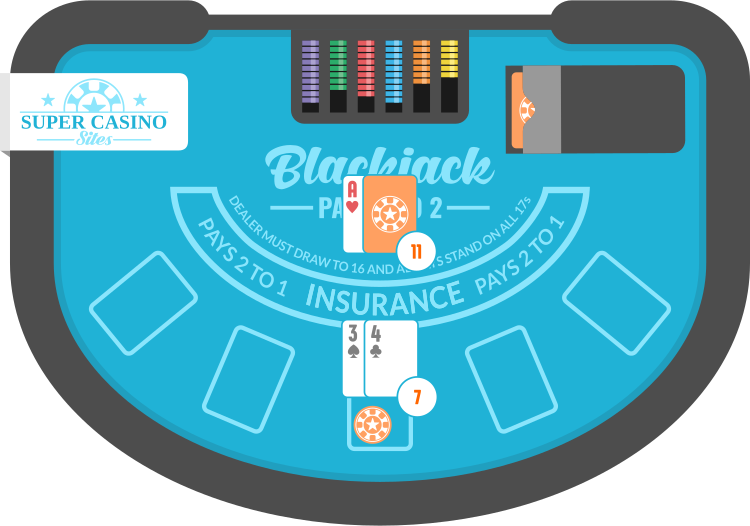
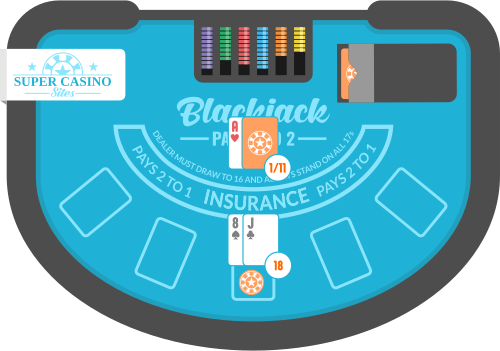
Soft and Hard Hands
Recreational players appreciate the game’s simplicity, and the rules take only ten minutes to learn. Before play begins, the dealer shuffles the cards and asks a player to cut the pack. The top card from the deck or shoe is then “burned,” meaning it is placed either at the bottom of the deck or in the discard tray.
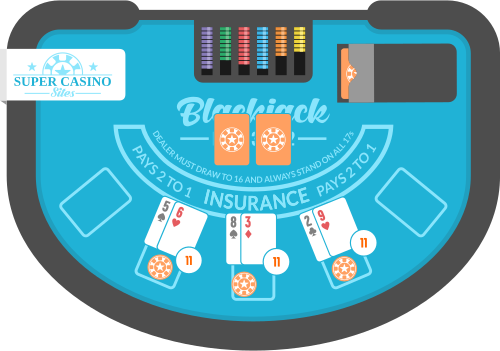
Each player places a bet and receives two cards. The dealer is the last to receive two cards, with only one card face up. In single- and double-deck games, all cards are dealt face down.
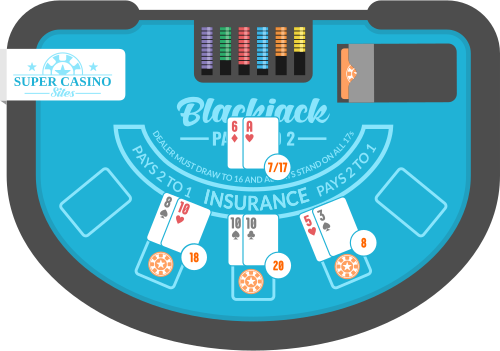
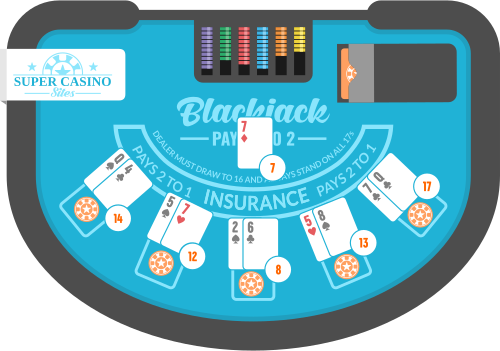
The goal is to form a hand as close to 21 as possible without going over. The dealer must follow fixed rules, drawing to a predetermined hand total that can vary between tables.
View more...The values of the cards are as follows:
- Cards 2 through 9 are worth their pip value.
- 10s and face cards (Queen, Jack, and King) have a numerical value of 10.
- Aces are worth either 1 or 11 depending on the player’s preference.
A hand totaling 21, formed with an Ace and a ten-value card, is called a “blackjack” or a “natural,” and it offers the highest payout, usually 3 to 2. Other winning hands normally return even money.
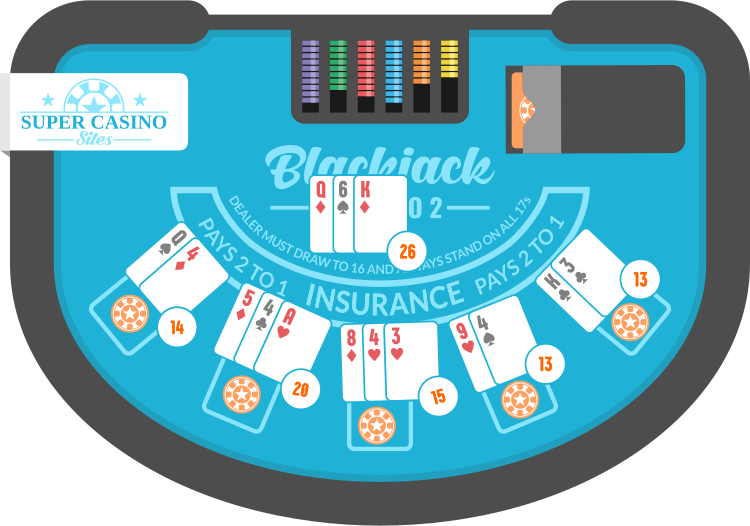
Anyone who exceeds 21 loses the hand or “busts.” When the dealer and the player end with the same total, the result is a push, and the player neither wins nor loses.
View more...Players can choose from the following actions:
- Hitting occurs when the player requests additional cards to improve the hand total after the initial deal. In land-based casinos, you signal a hit in shoe games by tapping the table.
- Standing is when the player is satisfied with the current total and declines additional cards. In shoe games, you indicate this choice by waving your hand over the cards.
- Doubling down can be one of the most profitable moves. You may double down on two-card totals immediately after the initial deal, before taking any hits.
You do so by posting an additional bet equal to, but not exceeding, your original stake. In exchange, you receive exactly one additional card. Doubling for less is possible, though generally considered poor play. - Splitting is available when you are dealt two cards of equal value, such as 8-8 or A-A. You post an extra wager equal to your original bet.
The dealer separates the pair into two hands and draws a card on each. You then play the hands one at a time. - Resplitting is permitted in many blackjack variants, although most casinos do not allow you to draw on split Aces.
Surrender is allowed immediately after the initial deal, meaning players cannot surrender after hitting, splitting, or doubling. To surrender is to forfeit your two-card hand in exchange for half of your original bet. There are two types of surrender:
- Late surrender lets you forfeit your hand after the dealer has checked the hole card for blackjack. This rule decreases the casino’s advantage by 0.08%.
- Early surrender can be exercised before the dealer peeks at the hole card. This favorable rule is rare at both online and land-based casinos and reduces the house advantage by 0.63%.
- Insurance is offered when the dealer’s upcard is an Ace. This side bet does not affect the odds of winning your initial hand. You place an additional wager equal to half of your original bet.
If the dealer has blackjack, your insurance bet pays 2 to 1. If not, you lose the insurance bet and play out your hand as usual. Because of its high house edge of 7.40%, players are generally advised to avoid this wager.
View more...One of the first lessons for novice players is the difference between soft and hard hands in blackjack. The distinction exists because the Ace can have two possible values, and each hand type requires a different strategy.
- Soft hands are more desirable because they contain an Ace, which can count as either 1 or 11.
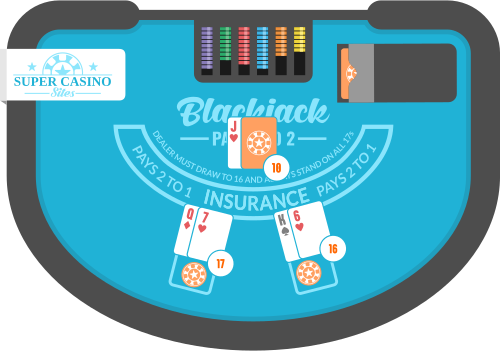
An example of a soft hand is A-4-3, which totals either 8 or 18. It is impossible to bust on the next hit with a soft total. If you catch a deuce, your Ace will be counted as 11, giving you a soft 20. If you pull a higher card, such as a 9, the Ace will be counted as 1 for a total of 17. - Hard hands are either Ace-less or include an Ace fixed at a value of 1 to prevent busting. Their rigidity makes them more susceptible to busting on the next hit. Examples include 8-9 for hard 17, Q-6 for hard 16, and K-K for hard 20.
Blackjack Rule Variations
Unlike many other casino games, blackjack does not follow one fixed set of rules. The rules vary depending on where you play, and each variation affects the house edge. Below are some of the most common blackjack rule variations you may encounter.
Deck Number
Blackjack can be played with anywhere from one to eight decks of cards. The house edge increases in direct proportion to the number of decks. The more decks in play, the higher the house edge, because the effect of card removal is diluted in multi-deck games.
The Dealer's Fixed Standing Rules
The dealer’s standing rules vary from table to table. Blackjack dealers do not make independent decisions when completing their hands. Instead, they must draw to the hand total specified by the casino. Based on these fixed rules, we can distinguish between two main blackjack formats:
- Dealer stands on soft 17 (S17): This rule favors players because 17 is generally below the average winning total in the game (18.5). It lowers the house edge by reducing the chance that the dealer will outdraw the player.
- Dealer hits soft 17 (H17): This rule works against players because the dealer cannot bust with one additional hit on a soft 17. In turn, the dealer may outdraw you by pulling small cards such as 2, 3, or 4. The H17 rule increases the casino’s advantage by 0.22%.
Doubling Down and Splitting Restrictions

At some tables you may double down only on specific two-card totals. Certain games let you double down on starting totals of 9, 10, and 11, while others are more restrictive and allow the play only on totals of 10 or 11.
Limiting doubling to 9 through 11 increases the house edge by about 0.09%. Restricting it to 10 and 11 raises the casino’s advantage by roughly 0.18%.
Splitting can also be restricted. Some games permit only one split, creating two hands. Doubling after a split (known as DAS) might be prohibited at some tables, which again boosts the house edge. Resplitting may be disallowed as well. Most commonly, players cannot resplit or hit split Aces.
Blackjack Payouts
This is one of the most important rule variations in blackjack. Some casinos pay 3 to 2 on blackjacks, while others pay 6 to 5. The difference is easiest to illustrate with an example. Imagine you can choose between Casino 1, which pays 6 to 5, and Casino 2, which pays 3 to 2. You plan to flat-bet $10.
A blackjack at Casino 1 pays 1.2 times (6/5) your stake, so you would receive $12 for a $10 bet.
A blackjack at Casino 2 pays 1.5 times (3/2) your stake, so you would receive $15 for the same $10 bet.
The better choice is clear. A savvy blackjack player should never sit at a 6-to-5 table, because this payout reduction increases the house edge by about 1.71%.
Blackjack Strategies
House Edge in Blackjack
Basic Strategy in Blackjack
Taking Your Blackjack Game to the Next Level

The house always holds a certain advantage over its patrons, and this is built into the payout percentages for winning bets. In games of chance such as roulette, this advantage remains constant because the odds never change; each spin of the wheel is an independent event and has no effect on future results. All players therefore face the same house edge.
This is not the case with blackjack, a game of dependent events. Each card dealt from the deck or shoe affects the odds of winning (or losing) on subsequent hands.
An abundance of ten-value cards tips the scales in favor of the player, while low-value cards benefit the dealer by reducing the chance of busting.
The ratio of high to low cards changes with every hand, and so does the house edge. It is also influenced by the casino’s fixed rules, which vary from one table to another.
Many skilled players exploit the game through advantage play, but you do not need to be a card counter to reduce the edge. By using optimal basic strategy, you can lower it to 0.50% or less. Without basic strategy, the house edge rises to about 2% and can be even higher at tables with unfavorable conditions.
View more...By using basic strategy, players can reduce the house edge and turn blackjack into a game with nearly even odds. Basic strategy is presented in the form of a chart that lists the optimal decisions players should make when they are not employing advantage-play techniques. The chart tells you when it is best to hit, split, stand, double down, or surrender.
There are two types of basic strategy.
- With total-dependent basic strategy, decisions are based solely on the dealer’s upcard and the total of your starting hand.
Each column in the strategy chart represents the dealer’s upcard, while the rows correspond to the player’s totals. The cells where rows and columns meet indicate the optimal move for every possible hand combination. - Many players use composition-dependent basic strategy, which is more accurate. Here, decisions are based on the dealer’s upcard and the exact composition of the player’s hand, that is, the number of cards and their ranks.
Players who follow perfect basic strategy are expected to win 49 out of every 100 hands in the long run. The strategy helps you:
- Maximize your profits during favorable situations
- Minimize your losses in disadvantageous situations
- Improve hands that would otherwise be sure losers
Keep in mind that basic strategy varies according to the specific rules of the blackjack variant you play, including the number of decks, the dealer’s standing rules, and the availability of surrender. The chart below corresponds to a multiple-deck, S17 game with DAS, allowing doubling on any two cards and late surrender.
| Players’ Hand | Dealer’s Up Card | |||||||||
|---|---|---|---|---|---|---|---|---|---|---|
| 2 | 3 | 4 | 5 | 6 | 7 | 8 | 9 | 10 | A | |
| 8 | H | H | H | D | D | H | H | H | H | H |
| 9 | H | D | D | D | D | H | H | H | H | H |
| 10 | D | D | D | D | D | D | D | D | H | H |
| 11 | D | D | D | D | D | D | D | D | D | H |
| 12 | H | H | S | S | S | H | H | H | H | H |
| 13 | S | S | S | S | S | H | H | H | H | H |
| 14 | S | S | S | S | S | H | H | H | H | H |
| 15 | S | S | S | S | S | H | H | H | H | H |
| 16 | S | S | S | S | S | H | H | H | H | H |
| A-2 | H | H | H | D | D | H | H | H | H | H |
| A-3 | H | H | D | D | D | H | H | H | H | H |
| A-4 | H | H | D | D | D | H | H | H | H | H |
| A-5 | H | H | D | D | D | H | H | H | H | H |
| A-6 | H | D | D | D | D | H | H | H | H | H |
| A-7 | S | D | D | D | D | S | S | H | H | H |
| A-8 | S | S | S | S | S | S | S | S | S | S |
| A-9 | S | S | S | S | S | S | S | S | S | S |
| A-A | SP | SP | SP | SP | SP | SP | SP | SP | SP | SP |
| 2-2. | SP | SP | SP | SP | SP | SP | H | H | H | H |
| 3-3. | SP | SP | SP | SP | SP | SP | H | H | H | H |
| 4-4. | H | H | H | SP | SP | H | H | H | H | H |
| 5-5. | D | D | D | D | D | D | D | D | H | H |
| 6-6. | SP | SP | SP | SP | SP | H | H | H | H | H |
| 7-7. | SP | SP | SP | SP | SP | SP | H | H | H | H |
| 8-8. | SP | SP | SP | SP | SP | SP | SP | SP | SP | SP |
| 9-9. | SP | SP | SP | SP | SP | S | SP | SP | S | S |
Some players have developed their skills to such an extent that they can eliminate the house edge when they sit at a blackjack table.
One technique that can provide an advantage is card counting. It is based on the idea that players can eventually beat the house by tracking the ratio of high to low cards remaining in the deck or shoe.
Each dealt card is assigned a count value, which helps the counter establish a running count. In multiple-deck games, this must be converted into a true count so that your playing and betting decisions are accurate.
High cards and Aces benefit the player, while low cards give the dealer a slight advantage. Card counters gain an edge by deviating from basic strategy and adjusting their bet size according to the count.
They increase their wagers when many high cards remain and, conversely, decrease their bets or leave the table when the shoe is rich in low cards.
When choosing a card-counting system, consider several factors:
- Betting correlation, or how effective the system is at identifying advantageous betting situations.
- Playing efficiency, which reflects how accurately the system identifies moments when the player should deviate from basic strategy.
- Insurance correlation, an indicator of how well the system determines when buying insurance is profitable.
The Hi-Lo Count
The Hi-Lo was invented by mathematician Harvey Dubner and is the most widely used counting strategy in blackjack. It is a balanced, level-one system in which ten-value cards and Aces are assigned a count value of -1, small cards 2 through 6 a value of +1, and cards 7 through 9 are neutral with a value of 0.
Most professional players and blackjack authors recommend the Hi-Lo because of its efficiency and simplicity. Because it is balanced, the running count must be converted into a true count. Players who use it are less prone to mistakes, which yields better results.
The Red Sevens Count
The Red Sevens is an unbalanced counting system invented by blackjack legend Arnold Snyder. It assigns different count tags to the cards: ten-value cards and Aces are counted as -1, small cards 2 through 6 as +1, the 8s, the 9s, and the black 7s are neutral with a value of 0, and the red 7s have a value of +1.
This system relies on a pivot number, which indicates when the odds have shifted in the player’s favor. This eliminates the need to convert the running count into a true count.
View more...
Land-based versus Online Blackjack
Blackjack is now available at a huge number of online casinos, where you can choose from a variety of games with different table limits and conditions. These games operate on random number generators, which reshuffle the cards after each round.
Licensed online casinos have their software audited by accredited testing agencies for the purpose of preserving the integrity of their games. This also ensures that you are playing a fair game of blackjack in which the results are completely random.
Major online casinos also allow their customers to play against live dealers. The blackjack action is streamed directly to their computer or smartphone screens in real time. The tables are managed by professional dealers you can interact with, just as you would in land-based casinos.
The only difference is that you must use the chat feature instead of speaking to the dealer. When the live dealer tables are full, you can bet behind other players until a vacant seat opens.
Some of the best online and live-dealer blackjack games come from the studios of established software suppliers like Microgaming, Evolution Gaming, NetEnt, Felt, Playtech, Betsoft, and Pragmatic Play.
The biggest advantages of playing online blackjack are:
- You can play at your own pace on your desktop computer, iOS or Android smartphone, or tablet
- Table limits are more flexible, with some online blackjack variations allowing wagers as low as $0.10
- You can switch between blackjack variations quickly
- Online players can take the necessary time to consult their strategy charts without other patrons rushing them
- The online blackjack tables are open around the clock, so you can play whenever you like
- There is no table etiquette to comply with
- You benefit from realistic graphics, authentic sound effects, and an intuitive gaming interface
- You can practice with demo credits before risking real money
There are only a few disadvantages to playing online blackjack, such as:
- The game may become monotonous after a while due to the absence of interaction with fellow players
- Online blackjack games, particularly those running on random number generators, are not susceptible to advantage play techniques like card counting
- You do not experience the exciting atmosphere of the land-based casino floor.
The Best Blackjack Variations to Try Online
Online blackjack players enjoy an unparalleled variety of game variations. You will find plenty of options online. Some versions offer friendlier rules and a lower house edge, while others provide a chance to win a progressive jackpot.
Remember to adjust your basic strategy to match the rules of the variation you choose. Below are some of the most popular versions you can play online.
Atlantic City Blackjack
Most standard blackjack rules apply to this variant, with a few key differences. In Atlantic City Blackjack, eight full decks are usually in play, although some online casinos offer double-deck versions. The goal remains the same: beat the dealer with a higher hand total. Atlantic City Blackjack follows these rules:
- The dealer stands on soft 17
- Blackjacks pay 3 to 2
- The player can double down on any two-card total
- The player can resplit up to three times, forming up to four hands
- Aces cannot be resplit
- You can double after you split
- Split Aces cannot be hit
- The dealer checks for blackjacks when revealing an Ace or a ten-value card
- Late surrender is allowed
Vegas Strip Blackjack
This variation takes its name from the blackjack games found along the Las Vegas Strip. You will commonly see it at Microgaming-powered online casinos. The rules in Microgaming’s version are quite player-friendly, better than those in some Strip casinos, and they reduce the house edge to roughly 0.35%.
- The game uses four decks
- Blackjack pays 3 to 2 (note that some Strip casinos have changed the payout to 6 to 5, which you should avoid)
- The dealer must stand on soft 17
- Surrender is not available
- Doubling on any two cards is allowed
- Doubling after a split is allowed
- You cannot resplit or hit split Aces
- You may split up to three times
Double Exposure
This engaging blackjack variation debuted in October 1979 at the Vegas World casino. It was created by mathematician Richard Epstein. You may encounter it under other names, including Face-Up Blackjack, Zweikartenspiel, and Dealer Disclosure Blackjack.
You can play Double Exposure online at casinos that use software from NetEnt, Microgaming, RealTime Gaming, or Play’n GO. The game follows these rules:
- The dealer receives both cards face-up
- Eight decks are in play
- Blackjacks pay 1 to 1
- The dealer wins all pushes
- Dealer hits soft 17
- Players may double only on 9, 10, or 11
- Resplitting is usually not allowed
- Doubling after a split is not allowed
- You cannot split ten-value cards unless they are identical
- Surrender is not available
Blackjack Switch
Invented by Geoff Hall, this is one of the most innovative blackjack variants. You play two hands instead of one and may switch their top cards to improve your totals. The game also offers Dealer Match side bets that can award higher payouts.
Our preferred online version of Blackjack Switch is developed by Playtech. Remember these key rules:
- The game uses six or eight decks
- You play two hands per round and may switch the top cards
- Dealer peeks for blackjack
- Blackjacks pay 1 to 1
- The dealer pushes with a total of 22
- Doubling on any two cards is allowed
- You may split any pair and resplit to four hands
- Surrender is not available
Pontoon
Pontoon is often treated as a blackjack variation, yet it differs so much that some experts regard it as an entirely separate game. Two main versions exist, adding to the confusion of newcomers. The version played in Australia, Malaysia, and Singapore uses short decks and is closer to Spanish 21.
The other version, more popular in the United Kingdom, resembles standard blackjack, and most online pontoon games follow its rules. You can find online Pontoon variants from RealTime Gaming, Microgaming, Betsoft, and Playtech. Pontoon is typically played under the following rules:
- The number of decks varies by casino
- Both dealer cards are dealt face-down
- Dealer hits soft 17
- Players must hit until they reach a total of 15
- Dealer wins all ties
- You may double after a hit
- Pontoons and winning five-card hands pay 2 to 1
Spanish 21
Spanish 21 is one of the most intriguing blackjack variants because it features numerous rule modifications. The game is ideal for fans of 21 who want more excitement than standard blackjack provides.
Online versions of Spanish 21 are available at casinos powered by Betsoft and Microgaming. The most common rules include:
- Six or eight short decks with 48 cards each (all 10s are removed)
- Dealer hits soft 17
- Blackjacks pay 3 to 2
- Late surrender is allowed
- Doubling on any two cards is allowed
- You may surrender after doubling
- You may hit split Aces and double on them
- Additional payouts are awarded for special totals of 21
Multi-Hand Blackjack
Some online blackjack variants let you play multiple hands at the same time. These games feature elegant designs and realistic animations, giving players a premium casino experience without leaving home.
You can choose from various chip denominations, though table limits differ between casinos. Our recommended multi-hand versions are provided by Microgaming, Play’n GO, Pragmatic Play, NetEnt, and Playtech.
Progressive Blackjack
Online blackjack fans can chase impressive jackpots by playing progressive variants of the game. These versions are linked to a networked jackpot and require an optional side bet, usually no more than $1, to qualify for the prize.
Jackpots are triggered by specific combinations of Aces or 7s, depending on the software provider. Some of the largest pots are found in progressive blackjack games from Microgaming, WGS Technology, and Playtech.