

Essendo uno dei giochi da casinò più popolari e semplici, la roulette è spesso considerata facile anche per i principianti. Ma per vincere davvero questo gioco, i giocatori devono avere una profonda conoscenza delle sue regole, che si sono evolute e modificate nel corso degli ultimi secoli.
Da quando la roulette è stata introdotta per la prima volta in Francia alla fine del XVIII secolo, si è diffusa in tutti i casinò e gli stabilimenti di gioco d’azzardo del mondo. Gli storici ritengono che sia stata ideata dal matematico e inventore francese Blaise Pascal nel tentativo di creare una macchina a moto perpetuo. In questa forma primitiva, il gioco era molto diverso da quello che conosciamo oggi. Eppure, è riuscito a diventare il gioco da casinò più facilmente riconoscibile al mondo.
Gran parte della sua popolarità potrebbe contribuire alla sua semplicità e al fatto che il risultato di ogni giro della ruota della roulette si basa sul puro caso piuttosto che su qualsiasi altra cosa. I giocatori non hanno bisogno di avere una particolare abilità o di usare strategie complesse per vincere – semplicemente scelgono un numero, fanno una scommessa e sperano che la fortuna sia dalla loro parte. Avere familiarità con le regole del gioco, tuttavia, può aumentare notevolmente la possibilità di vincere perché, in effetti, alcune scommesse sono migliori di altre.
In questo articolo, ci concentreremo sulle regole standard della roulette che si applicano praticamente a tutte le forme di roulette dei giorni nostri – sia che si giochi in un casinò vero e proprio o che si preferisca la versione virtuale della roulette che si trova nei casinò online.
 I migliori casinò bonus
-
€1000
 100% fino a €1000Solo per nuovi giocatori: Ricarica minima 10€ • 100% di Bonus Immediato sulla prima ricarica fino a 1.000€ • Il Bonus ha una durata di 30 giorni e "Requisito di puntata pari a 35" • Il Bonus va richiesto entro 14 giorni • Le 50 Free Spin (FS) sono valide esclusivamente per alcuni giochi • Le FS devono essere richieste entro 30 giorni ed utilizzate entro 7 giorni • Le vincite accumulate utilizzando FS saranno accreditate sotto forma di Bonus Casinò con una durata di 90 giorni e "Requisito di puntata pari a 35" • La contribuzione al requisito di puntata varia a seconda dei giochi • Valido solo su giochi specifici • L’offerta non può essere combinata con altre promozioni • Si applicano restrizioni sulla ricarica fino al completamento dei Requisiti di puntata • Non è possibile centrare i Jackpot utilizzando i FunBonus (Giocate Gratis e Free Spin) • Le puntate effettuate tramite FunBonus (Giocate Gratis e Free Spin) non contribuiscono a formare l’ammontare del Jackpot • Si applicano restrizioni sui prelievi • Si applicano Termini&CondizioniRichiedi il bonusVisita 888casino
 -
€100
 50% fino a €100Solo nuovi giocatori. Deposito minimo €20. Requisiti di puntata 50x. Si applicano varie contribuzioni dei giochi. Il bonus è valido per 7 giorni. Si applicano i Termini e condizioni completi e limitazioni di prelievo.Richiedi il bonusVisita Betway Casinò
 -
€100
 50% fino a €100Solo nuovi giocatori. Deposito minimo €10. Requisiti di puntata 35x. Si applicano varie contribuzioni dei giochi. Il bonus è valido per 14 giorni. Si applicano i Termini e condizioni completi e limitazioni di prelievo.Richiedi il bonusVisita LeoVegas Casinò



Le basi della roulette
In traditional casinos, roulette is played on a large wooden table, and the seats around it are reserved for players only. A casino employee, known as the croupier, announces the winning numbers, collects the bets, and pays out the winnings. In the classic version of the game, the croupier spins a ball around a wheel that has numbered pockets from 0 to 36, and American roulette includes an additional 00 pocket.
When the wheel stops, the croupier calls the number whose pocket the ball has landed in. Anyone who has placed a wager on that number (or on the color or category that includes that number) receives a fixed payout according to the rules of the game. Bets are made with casino chips that represent various amounts of money (€1, €5, €10, €50, and so on). Once the ball is released, or once the croupier calls “No more bets”, every stake on the table is final and cannot be moved or removed.
This brings us to another key element of the game, the table layout. The betting surface is covered with green felt (sometimes blue, red, or purple) that displays a chart with every number from the wheel. It is a simple rectangular diagram that shows all possible wagers along with their respective payouts, and chips are placed directly on top of it. As you can see, the rules are fairly straightforward and usually become clear after just a few spins. There are, however, a few details players should watch for, such as the different wheel types and table layouts.
 Le ruote della roulette
  Disposizione del tavolo della roulette
 Scopo e regole del gioco
 Lo scopo del gioco è davvero semplice e diretto – prevedere correttamente dove la palla atterrerà dopo che la ruota smette di girare. Come potete immaginare, è più facile a dirsi che a farsi, soprattutto quando si gioca alla roulette virtuale. In confronto, quando si gioca al gioco fisico, nella vita reale, i giocatori professionisti possono individuare diverse irregolarità nella ruota a causa dell’usura. In base ad esse, possono vedere come e se la ruota è influenzata in qualche modo e se alcune sezioni e numeri sono in realtà più probabili che vengano colpiti.
Quando si tratta di roulette virtuale online, tuttavia, l’esito di ogni giro è casuale e non può essere previsto come garantito dall’uso di un software speciale chiamato Random Number Generator (RNG). Una volta che i giocatori mettono le loro fiches sul tavolo, devono premere il pulsante Spin e il computer determinerà il numero vincente. Il risultato non è influenzato dalle rotazioni passate o future – ogni volta, i giocatori ottengono 1 numero vincente e 36 numeri perdenti (o 37 numeri perdenti nella roulette americana a doppio zero).
Se i giocatori hanno indovinato con successo il numero vincente o i gruppi di numeri, vincono e ricevono una vincita che è un multiplo della loro puntata originale. Ogni tipo di scommessa ha una vincita diversa, ma la regola generale è che le scommesse, che hanno più probabilità di vincere, hanno una vincita inferiore. Più il risultato è improbabile, più alta è la ricompensa potenziale.
Per esempio, il settore Rosso sullo schema delle scommesse paga in modo uniforme – 1 a 1, che a volte viene visualizzato come 1:1 o anche 2:1, poiché riceviamo la nostra scommessa originale più 1 unità. Allo stesso tempo, questa scommessa è molto probabile che vinca, poiché ci sono 18 numeri rossi sulla ruota. Le probabilità di colpire il numero 5, invece, sono molto più basse – 1 su 37, motivo per cui la vincita è molto più interessante a 35:1.
Scommesse e vincite
One of the most important aspects of roulette is the betting itself, for a very simple reason: choosing the right type of bet can increase your chances of winning. As we showed in the previous example, some wagers have a higher probability of success than others. That is why players should understand the basic bet types before they start playing roulette for real money.
In addition, many roulette players like to combine several bets to cover more of the board. Even the best staking strategy, however, cannot alter the built-in odds of the game, meaning it is impossible to gain an edge over the casino. Knowing the different wagers and their respective payouts, on the other hand, is crucial for judging the value of each bet and its expected return.
 Scommesse esterne
  Scommesse interne
 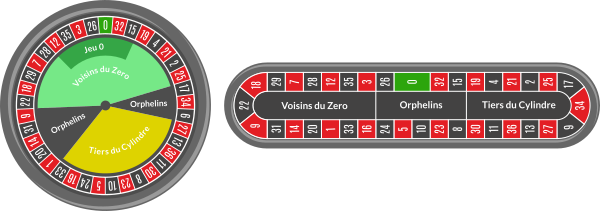 Scommesse annunciate
 Limiti di scommessa
 Prima di iniziare un gioco con denaro reale, gli avventori del casinò dovrebbero sempre tenere conto dei limiti di scommessa. A seconda del tipo di casinò, della variante della roulette e, a volte, anche dello status VIP del giocatore, le puntate minime e massime saranno diverse. Questo è estremamente importante in quanto i giocatori con un budget di €100 non sarebbero in grado di giocare nemmeno qualche giro se il tavolo minimo è di €50. Si raccomanda di scommettere un massimo dell’1%-2% del proprio budget su un singolo giro. Quindi, quelli con un budget di soli €100 non dovrebbero scommettere più di €2 per giro.
Molti casinò online offrono ai loro clienti puntate minime di €1, ma i limiti variano da un casinò all’altro. Ci sono anche tavoli a basso limite con puntate da €1 a €10 per spin e tavoli ad alto limite con puntate da €50 a €500 per spin. La maggior parte dei casinò utilizzano un modello progressivo per determinare l’importo massimo delle puntate per ogni tipo di scommessa. Se, per esempio, il casinò accetta scommesse dirette fino a €250, la puntata massima su split sarebbe di €500 (2x). La puntata massima consentita su una street sarà di €750 (3x), su una scommessa all’angolo – €1.000 (4x), su una linea a sei – €1.500 (6x), su dozzine e colonne – €1.750 (7x), e su basso/alto, pari/dispari, e rosso/nero – €2.000 (8x).
Regole addizionali della roulette
There are several extra rules that appear in certain roulette variants. Three of them, known as Surrender, En Prison and La Partage, apply specifically when 0 or 00 wins. These rules are not always offered by casinos and are particularly rare in online roulette versions. Because they reduce the house edge, they are quite popular among professional and experienced players.
 Resa
Resa  Regola “La Partage”
  Regola “En Prison”